Wednesday, May 17, 2006
MacBook: user-swappable hard disk
Below the two RAM slots (at the base of the battery cavity) is where you'll find the MacBook's hard disk drive. Without disassembling the notebook, users will be able to quickly removing some protective aluminum shielding and lift the drive out of the computer.
Source: http://www.appleinsider.com/article.php?id=1750
MacBook: glossy screen
Here is the most extensive documentation yet of the drawbacks of the new glossy screen on the MacBook, now also available as an option for the MacBook Pro. Here are some more photos.
Tuesday, May 16, 2006
MacBook: not for the paranoid?
For instance, when you’re in a dark room, MacBook turns down the brightness. Just one of the many ways MacBook conserves energy out of the box, optimizing both AC and battery power.
Says the Apple website. Although it is possible that the MacBook has a separate light/dark sensor, I'm guessing they measure brightness using the camera. I hope either this feature or the actual camera itself can actually be switched off. Not everyone wants a Paris Hilton incident in the home. Yes, cover that camera when not in use! Did you know that Flash may be able to access your audio-in? Hah, scary...
MacBook
So the news is out.
The MacBook, now for sale, has a 13 inch widescreen display (1280 x 800 where I had anticipated closer to Sony's 1366 x 768), a mini-DVI output which requires an inexpensive (15 GBP) adapter for either a DVI or VGA socket on your display. It also features the dual-core CoreDuo processor, from 1.83GHz, where many expected to see a "CoreSolo" for the cheaper end of the range.
The anticipated black finish is only available for the 2GHz 80GB+ model, at an 89 GBP premium! Its budget nature is revealed, however, when considering the weight: The MacBook weighs in at a sizeable 2.36kg, comparing unfavourably, for example, to the superiorly configured Sony VAIO VGN-SZ110B, which weighs only 1.86kg.
We shall have to wait for news on battery life (not expected to diverge from the MacBook Pro), thermal paste, whine and MagSafe. Some people are curious about GPU performance.
The MacBook, now for sale, has a 13 inch widescreen display (1280 x 800 where I had anticipated closer to Sony's 1366 x 768), a mini-DVI output which requires an inexpensive (15 GBP) adapter for either a DVI or VGA socket on your display. It also features the dual-core CoreDuo processor, from 1.83GHz, where many expected to see a "CoreSolo" for the cheaper end of the range.
The anticipated black finish is only available for the 2GHz 80GB+ model, at an 89 GBP premium! Its budget nature is revealed, however, when considering the weight: The MacBook weighs in at a sizeable 2.36kg, comparing unfavourably, for example, to the superiorly configured Sony VAIO VGN-SZ110B, which weighs only 1.86kg.
We shall have to wait for news on battery life (not expected to diverge from the MacBook Pro), thermal paste, whine and MagSafe. Some people are curious about GPU performance.
Thursday, May 04, 2006
The Unix-Windows security debate
The Windows guys say when OS X becomes common, it will be affected by viruses just as much (the epidemiology standpoint). The Unix guys say, no, because Unix is designed as a multi-user system with restricted user and file permissions from the ground up, so viruses have far fewer avenues for propagation (the system design standpoint).
And then there are userland macro/script viruses, where the unix file permissions don't apply, a problem common to all pluggable applications, especially where the user is a) not asked to consent to execution of a b) digitally signed macro.
That's as much as there is to this debate. Simple, hmm?
And then there are userland macro/script viruses, where the unix file permissions don't apply, a problem common to all pluggable applications, especially where the user is a) not asked to consent to execution of a b) digitally signed macro.
That's as much as there is to this debate. Simple, hmm?
Monday, May 01, 2006
Major embarrassment for Apple: thermal paste in MBP
As nicely illustrated in this forum post, Apple manufacturers have been applying excess amounts of thermal paste to all relevant bits of hardware, hence . Not only has this led to questions whether the MacBook will be similarly affected, besides being the reason why MacBook Pros are not designated "laptops", it has even led to suggestions (pending investigation) that this problem may have afflicted PowerBooks and G5 computers, and that Apple's move to Intel hardware may have been mostly motivated by what has now turned out to be the result of incorrect application of heat paste. Yes, embarrassing!
Friday, April 28, 2006
Computers with Mactel hardware?
If anyone can explain to me why Mac OS X-compatible hardware budget offerings from third party manufacturers aren't popping up all over the place, I'll be glad to hear it - sure, they couldn't deliver them with OS X pre-installed, or they'd be liable. But there sure must be quite a few customers out there wanting a slice of OS X goodness without the price tag! (Who cares if the customers break the license terms?)
Tuesday, April 25, 2006
Darwine on Mac OS X
To join in with speculation by John Martellaro and others (John suggests that Mac OS X could be partly replacing its rumoured virtual machine to run XP, Vista and Linux, with a Darwine implementation for Vista), I would like to point out that Wine is almost feature-complete for XP, so Apple could give Microsoft a quicker death by quenching Vista in its pram - support XP apps via Darwine NOW, and eradicate any developer desire to support Vista (as it will have smaller market share than XP probably forever). If there are no apps that depend on Vista, consumers likely won't want it either!
Steve Ballmer foresaw it when he chanted "developers, developers, developers, developers" - unless developers use the new Vista features, the platform will die because it does not offer considerable user interface improvements in the way that OS X increments do (Exposé, Spotlight, etc.)
Steve Ballmer foresaw it when he chanted "developers, developers, developers, developers" - unless developers use the new Vista features, the platform will die because it does not offer considerable user interface improvements in the way that OS X increments do (Exposé, Spotlight, etc.)
Friday, April 21, 2006
Windows XP API in Mac OS X 10.5?
Here goes Cringely again, suggesting that Mac OS X will fully support Windows XP apps natively; what he neglects to mention is that this would totally kill Windows Vista, as it would mean that no software vendor other than MS will develop their apps beyond the API offered by XP (since using Vista-specific features will lose them the Mac OS X installed base, while using only XP features will allow them to stop developing a Mac OS X specific version...).
So here we would have a company that used to sell its hardware because the hardware supported a unique, user-friendly OS that everybody wanted, changing into a company that sells good hardware (I doubt XP apps would be supported in Macish way (menu bar at top etc.) But then Cringely claimed in his previous column that Sony would beat Apple on delivery time, so what's happening here? Is Apple's demise in the wings? Can they survive on the quality of Mail and Preview alone (which I think will not be included in the OS X compatibility kit for Windows)?
So here we would have a company that used to sell its hardware because the hardware supported a unique, user-friendly OS that everybody wanted, changing into a company that sells good hardware (I doubt XP apps would be supported in Macish way (menu bar at top etc.) But then Cringely claimed in his previous column that Sony would beat Apple on delivery time, so what's happening here? Is Apple's demise in the wings? Can they survive on the quality of Mail and Preview alone (which I think will not be included in the OS X compatibility kit for Windows)?
Tuesday, April 18, 2006
The advent of the mount virus
I had previously wondered whether the large number of Linux-Windows dual boot systems would attract viruses that can propagate between the two operating systems (OS), making a relatively secure OS (e.g. Linux, if up to date with security patches) insecure by association with an insecure OS (e.g. Windows, even if up to date with security patches).
Gartner last week published an advisory stating that Mac OS X is at no additional risk from viruses through dual booting. While it is correct that current Windows viruses cannot infect Mac OS X on a dual boot system, it is also true that there are a lot of open code bases that include a plethora of file system drivers that could be ported to Windows by ambitious virus authors. It is also true that an OS can usually be identified by the file system it's on, for historical reasons not worth going into.
The best advice, as always, is to use your insecure OS (yes, Windows) only on virtual machines.
Update 25/04/2006:
Looks like we may be skipping the dual boot virus stage and heading straight for VM rootkits. This seems to be in line with rumours that Apple's next operating system release will have a virtual machine to run Windows and Linux operating systems as guests, included.
Update 02/05/2006:
Finally someone hears me.
Update 11/10/2006:
Link - link - somewhat related topic
Gartner last week published an advisory stating that Mac OS X is at no additional risk from viruses through dual booting. While it is correct that current Windows viruses cannot infect Mac OS X on a dual boot system, it is also true that there are a lot of open code bases that include a plethora of file system drivers that could be ported to Windows by ambitious virus authors. It is also true that an OS can usually be identified by the file system it's on, for historical reasons not worth going into.
The best advice, as always, is to use your insecure OS (yes, Windows) only on virtual machines.
Update 25/04/2006:
Looks like we may be skipping the dual boot virus stage and heading straight for VM rootkits. This seems to be in line with rumours that Apple's next operating system release will have a virtual machine to run Windows and Linux operating systems as guests, included.
Update 02/05/2006:
Finally someone hears me.
Update 11/10/2006:
Link - link - somewhat related topic
Sunday, April 16, 2006
Microsoft and Beagle
Many within the Linux community have expressed well-justified concerns at building such a crucial desktop tool as a desktop search engine on a technology patented to Microsoft - .NET. It is good to see that the warnings have been heeded, and Beagle is an optional addition to GNOME, which also includes a more traditional, but slower, replacement of most of the functionality.
However, luckily for us, it seems that Microsoft is temporarily preoccupied with figuring out what Apple are up to, and it can be hoped, although should not be assumed, that the Microsoft vs. Mono debate will never resurface.
However, luckily for us, it seems that Microsoft is temporarily preoccupied with figuring out what Apple are up to, and it can be hoped, although should not be assumed, that the Microsoft vs. Mono debate will never resurface.
How Apple can catch up with Linux
There are two elements missing from Apple's Mac OS X desktop environment that set productivity under Linux apart:
- Paste action of middle mouse button (yes, Mighty Mouse is the right direction).
- One-click responsiveness of windows not belonging to the currently active application.
Finally, Finder really needs a big update now that encompasses Spotlight functionality (more file info in Spotlight, instant conversion of Spotlight searches to Smart Folders), but I believe this is in the works for Leopard already.
Finally, by making Windows apps run on OS X, or OS X apps on Windows, Apple could grab some of the Windows-entrenched niche markets such as those tied to Windows-bound GIS and CAD applications and traditionally relying heavily on superior workstation processing power.
Landslide towards Apple
With slim, widescreen machines promised as the "MacBook" replacement of the iBook for May or June according to rumours, possibly in several colours and with DVI-Out connectivity, there will be a landslide of customers towards Apple, unless further hardware problems emerge (a possible source of which could be Apple's inclusion of flash memory, between hard disk and RAM in the sequence of memory elements; there is no precedent for this in any hardware sold by the company). The next release of the operating system, Leopard, will be well placed to steal away further market share, especially if Apple manages to keep the footprint small (an area where Vista is especially vulnerable).
At the other end of Apple's business, there is a risk of losing mp3 player market share unless they can revitalise their range with colourful models to mimic the appeal of the iPod Mini. Note the negative knock-on effect this could have on their iTunes Music Store. France has taken a lead in asking Apple to unlock iTunes for other mp3 player manufacturers, and further countries are likely to follow. In fact, Apple's losing mp3 player market share may force such a move of the company's own accord to keep the store alive. I very much doubt it will come to this, but it is clear that Apple has to continue remaining competitive on price and innovation, especially since in spite of their promotion of podcasting, this has remained a niche market.
At the other end of Apple's business, there is a risk of losing mp3 player market share unless they can revitalise their range with colourful models to mimic the appeal of the iPod Mini. Note the negative knock-on effect this could have on their iTunes Music Store. France has taken a lead in asking Apple to unlock iTunes for other mp3 player manufacturers, and further countries are likely to follow. In fact, Apple's losing mp3 player market share may force such a move of the company's own accord to keep the store alive. I very much doubt it will come to this, but it is clear that Apple has to continue remaining competitive on price and innovation, especially since in spite of their promotion of podcasting, this has remained a niche market.
How Microsoft can save their ass
Seeing that Microsoft has been feeling the Linux threat for a while, and that Apple will start eating into its OEM dealers' sales even more heavily once the iBook replacements (aka MacBook) go on sale, how can Microsoft draw back from this two-front battle and vow new customers with superior technical features?
Here are a few suggestions:
Here are a few suggestions:
- expand the shell capabilities (find, grep, easy batch processing etc.)
- include an installer/updater interface that allows installing commercial software (similar to iTunes Store; the precedent has been set; customer acceptance could be high if it wasn't Microsoft...) at a button press, including upgrade deals for installed software; that also allows updating all applications to newest version, not just Microsoft ones; that allows downloading/compiling newest FOSS software (Gnumeric, Abiword, Gimp, Gaim, XChat, etc.) at the press of a button (yes, include a compiler free of charge!)
- one single version priced at 99 USD to compete with Apple's OS pricing and eliminate customer confusion
Note that all of these points are about the user experience rather than the raw processing ability, whereas many Microsoft innovations due to arrive with Vista address the latter (e.g. WinFS). Also note my upcoming post about Apple.
Friday, April 14, 2006
Photography: perfect picture vs. artistic freedom
There is a rift running through the photographing community, a rift between amateurs and press photographers on the one hand, who want a picture perfectly sharp, with colours as natural as possible and maximum depth of focus. Others, let's call them the artists, want to control every aspect of their exposure, and may be more open to post-production manipulation. Both, of course, have certain priorities in common. Fast start-up times and high exposure frequencies are on that wishlist.
This rift is not reflected in the current marketing strategies for cameras. Models are not sold separately to the two groups, and cameras come with a plethora of modes, an easy-to-use all-manual one often being absent. And there are other niceties that I can't seem to find - how about, for instance, an SLR camera whose lens automatically opens when you pick it up (or not if you switched off that feature)?
This rift is not reflected in the current marketing strategies for cameras. Models are not sold separately to the two groups, and cameras come with a plethora of modes, an easy-to-use all-manual one often being absent. And there are other niceties that I can't seem to find - how about, for instance, an SLR camera whose lens automatically opens when you pick it up (or not if you switched off that feature)?
Wednesday, April 12, 2006
Apple's motivation for BootCamp?
Different views are being expressed about this. Two that I found interesting:
Robert Cringely has a different take on things. He sees Microsoft as the only immediate beneficiary, but danger is in the wings:
The only other time that I read Cringely, he postulated a merger of Apple and Intel, one that we have yet to see. Also compare with my earlier post on the future development of the operating systems market.
He did it to finally castrate Redmond's last stranglehold on Apple; to wit, "Office:mac." (sic) No longer would Apple be subject to the MBU's whims, threats, foot-draggings and feigned indifference to gain leverage and force Apple to do its bidding. The impetuous, jealous and child-like Bill Gates made truck-loads of cash peddling the horrendous (but vital to millions because, as Chef Joanna says "it's what everyone else uses") Office to Mac users, but it's not like he needed the money. No, it did something much more entertaining for Bill- it gave him power over Steve. Now, if Microsoft folds up the MBU tents (takes its ball and goes home), who cares? Windows can be run on a Mac, along with Office or any other crappy-but-necessary Windows "proggie."Source
Robert Cringely has a different take on things. He sees Microsoft as the only immediate beneficiary, but danger is in the wings:
I predict that Apple will settle on 64-bit Intel processors ASAP (with FireWire 800 please), and at that time will announce a product similar to Boot Camp to allow OS X to run on bog-standard 32-bit PC hardware, turning the Boot Camp relationship on its head and trying to sell $99 copies of OS X to 100 million or so Windows owners.Source
The only other time that I read Cringely, he postulated a merger of Apple and Intel, one that we have yet to see. Also compare with my earlier post on the future development of the operating systems market.
Sunday, April 09, 2006
Biggest drawback of web applications: slow load times
I recently tested some RSS reader websites, and my conclusion is that the response times are not satisfactory for these to replace desktop newsreaders. Bloated code may sometimes be to blame, and anyone who's looked at the output from Apple's iWeb will know what I mean. In one case, I got suspicious and looked more closely; the design did not strike me as overly sophisticated and clearly would be manageable with a small amount of CSS. But here, one humungous chunk of JavaScript gets loaded every time you view a page - 12KB of code that remains the same, and the rest of the page unnecessarily written in DHTML.
The JavaScript could be cached as a separate file by the browser, and the rest should probably be static or cached on the server. In fact, this is a good example of where user event-based caching can be used. Each user has a namespace of urls, which I will call userspace, that he or she can access only after logging in. Hence, these pages can be generated and loaded into cache when the user enters, and purged when he or she logs out, or if the user becomes inactive and there is competition for memory on the server.
But to back away from the technical for a moment, what we are seeing is competition between bandwidth and small footprint of web applications on the one hand [1], and processor speed and application efficiency for desktop applications on the other. It's still a question of time before the web wins out completely, and the browser becomes the operating system.
[1] Don't worry about the servers - they'll be up to scratch if the demand and competition are there (user demand for web services; competition for speed of delivery).
The JavaScript could be cached as a separate file by the browser, and the rest should probably be static or cached on the server. In fact, this is a good example of where user event-based caching can be used. Each user has a namespace of urls, which I will call userspace, that he or she can access only after logging in. Hence, these pages can be generated and loaded into cache when the user enters, and purged when he or she logs out, or if the user becomes inactive and there is competition for memory on the server.
But to back away from the technical for a moment, what we are seeing is competition between bandwidth and small footprint of web applications on the one hand [1], and processor speed and application efficiency for desktop applications on the other. It's still a question of time before the web wins out completely, and the browser becomes the operating system.
[1] Don't worry about the servers - they'll be up to scratch if the demand and competition are there (user demand for web services; competition for speed of delivery).
Saturday, April 08, 2006
Sidebar design done right
I'm not usually fond of Microsoft's UI designs, but in the case of MS Office 2003 products, they've outdone themselves. Look at this example of easy navigation between different sidebar options:

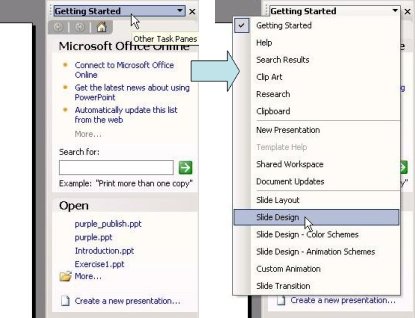


Now compare this to how it looks in Firefox:
The search bar is a nice touch and somewhat redeeming feature, but having fast navigation between different sidebar options would be even better!
Update 24/04/2006:
The All-In-One Sidebar Firefox extension looks like a good alternative solution, although I've yet to test whether it will accommodate Document Map, which, to add annoyance, is broken in the current Firefox release (1.5.0.2).
Wednesday, March 15, 2006
Apple Intel transition: third-party app killer?
Digg This!
It is clear that several of the top third party applications on Apple Macs will only run under the Rosetta Stone emulation, which renders them slower on the Mactels than they would be on the G4/G5 being phased out. This would include Microsoft Office (which competes with iWork) and products by Adobe and other graphics specialists (which compete with the "Pro" applications, such as the new Aperture). Interestingly, Apple made sure that other crucial applications, such as Wolfram's Mathematica, were swiftly ported, and helped them do so. I've no doubt that Apple's own applications are already available as Universal Binaries, and will run at native (Intel compiler?) speeds on the Mactels.
Needless to say, Apple would also be doing the open source movement a favour if it contributed to breaking the MS Office lock-in (and note the fact that Mac OS X has allowed creating PDFs from MS Office documents for a long time, whereas in Windows, you needed PDFCreator to do so).
tags:apple, mac, macintosh, ppc, intel, mactel, adobe, x86, mathematica, aperture,apple-intel, apple-intel transition, microsoft, microsoft office, macintel
It is clear that several of the top third party applications on Apple Macs will only run under the Rosetta Stone emulation, which renders them slower on the Mactels than they would be on the G4/G5 being phased out. This would include Microsoft Office (which competes with iWork) and products by Adobe and other graphics specialists (which compete with the "Pro" applications, such as the new Aperture). Interestingly, Apple made sure that other crucial applications, such as Wolfram's Mathematica, were swiftly ported, and helped them do so. I've no doubt that Apple's own applications are already available as Universal Binaries, and will run at native (Intel compiler?) speeds on the Mactels.
Needless to say, Apple would also be doing the open source movement a favour if it contributed to breaking the MS Office lock-in (and note the fact that Mac OS X has allowed creating PDFs from MS Office documents for a long time, whereas in Windows, you needed PDFCreator to do so).
tags:apple, mac, macintosh, ppc, intel, mactel, adobe, x86, mathematica, aperture,apple-intel, apple-intel transition, microsoft, microsoft office, macintel
Subscribe to:
Posts (Atom)